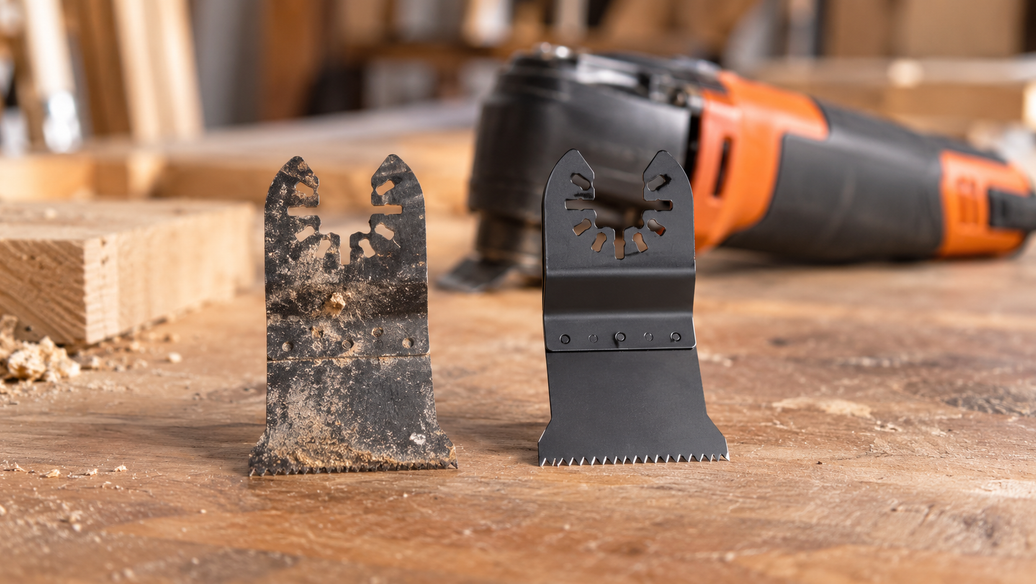
Multitool saw blades are available in various widths. Sometimes a narrow saw blade is the best choice, while for another job you can work faster and more accurately with a wide saw blade.
The right width depends mainly on the type of cut, the available space, and the material you want to work on. In this article, we explain when it is best to choose a wide or narrow multitool saw blade.
What is the difference between a wide and narrow saw blade?
The main difference lies in the width of the cutting part. A narrow saw blade makes a relatively small cut and is therefore easy to guide. A wider saw blade contacts more material at once and offers more stability during straight cuts.
Both types therefore have their own advantages. It is especially important to match the saw blade to the job.
When do you choose a narrow multitool saw blade?
A narrow saw blade is especially useful when accuracy is important or when you have little space to work.
For small cutouts
Do you want to make a small opening for a cable, pipe, or mounting point, for example? Then a narrow saw blade gives you more control.
You can determine more accurately where the cut begins and prevent removing unnecessarily large amounts of material.
For hard-to-reach places
In corners, along door frames, or between other structural components, there is often little working space. A narrow saw blade fits more easily between obstacles and is therefore very suitable for this type of work.
For precise plunge cutting
One of the strengths of a multitool is that you can start cutting in the middle of a material. A narrow plunge saw blade is ideal when such a cutout needs to remain small and precise.
Think, for example, of an opening in a wooden panel, laminate, or plasterboard.
For curved or corrective cuts
Although a multitool is mainly used for straight cuts, a narrow blade is easier to guide slightly than a wide blade.
This can be a great advantage for fine adjustment work.
When do you choose a wide multitool saw blade?
A wide saw blade is especially suitable when you want to make a longer, straight cut or remove a relatively large amount of material.
For straight cuts
Due to the larger cutting surface, a wide saw blade sits more stably in the material. This makes it easier to follow a straight line.
This is, for example, useful when shortening skirting boards, wooden panels, or floorboards.
For faster cutting
Because a wide saw blade uses more teeth at the same time, it can remove material faster during certain tasks.
This can work particularly well with relatively soft materials such as wood.
For flush cutting
A wide saw blade offers a lot of stability when you want to cut something flush along a surface.
Think, for example, of a protruding dowel, wooden joint, plastic part, or other protruding material.
For larger cutouts
Do you need to make a larger opening? Then a wider saw blade can be more efficient, because you remove more material per movement.
Narrow or wide saw blade: which works more accurately?
For small and detailed tasks, a narrow saw blade usually gives the most control. For longer straight cuts, a wide saw blade provides more stability.
Which variant is the most accurate therefore depends entirely on the type of cut you want to make.
Also pay attention to the length of the saw blade
In addition to the width, the length of a multitool saw blade is also important. A longer blade can cut deeper into the material, but may feel slightly less stable during fine work.
For surface-level and precise tasks, a shorter saw blade is often sufficient. If you need to cut through a thicker piece of wood or other material, you will need sufficient cutting depth.
The width does not tell the whole story
When choosing a multitool saw blade, do not look only at the dimensions. The material of the saw blade and the type of teeth are at least as important.
- Wood saw blade: for fast cutting in wood, MDF, and particleboard.
- Bi-metal saw blade: for wood with nails and various metal applications.
- Carbide saw blade: for harder and more abrasive materials.
- Diamond saw blade: for joints and stone-like materials.
So first choose a saw blade that is suitable for the material, and then determine which width best suits the job.
Which width do you need?
As a simple rule of thumb, you can assume:
- Narrow saw blade: for small cutouts, precision work, and hard-to-reach places.
- Wide saw blade: for longer straight cuts, flush cutting, and faster material removal.
Do you regularly work with a multitool? Then it is useful to have several widths in your toolbox. This way, you can use the most suitable saw blade for every job.
The right multitool saw blade makes the difference
A wide saw blade is not automatically better than a narrow saw blade, and vice versa. It is mainly about the application. With a suitable saw blade, you work more controlledly, faster, and get a neater result.
Looking for the right saw blade for your multitool?
View the range of multitool saw blades from MultiToolWorld and choose the right width and version for your job.