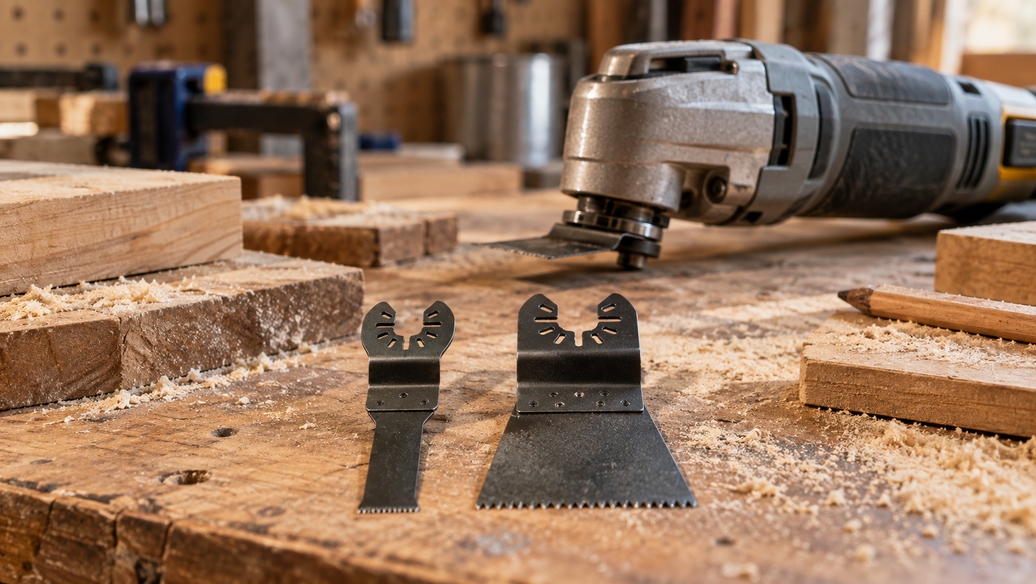
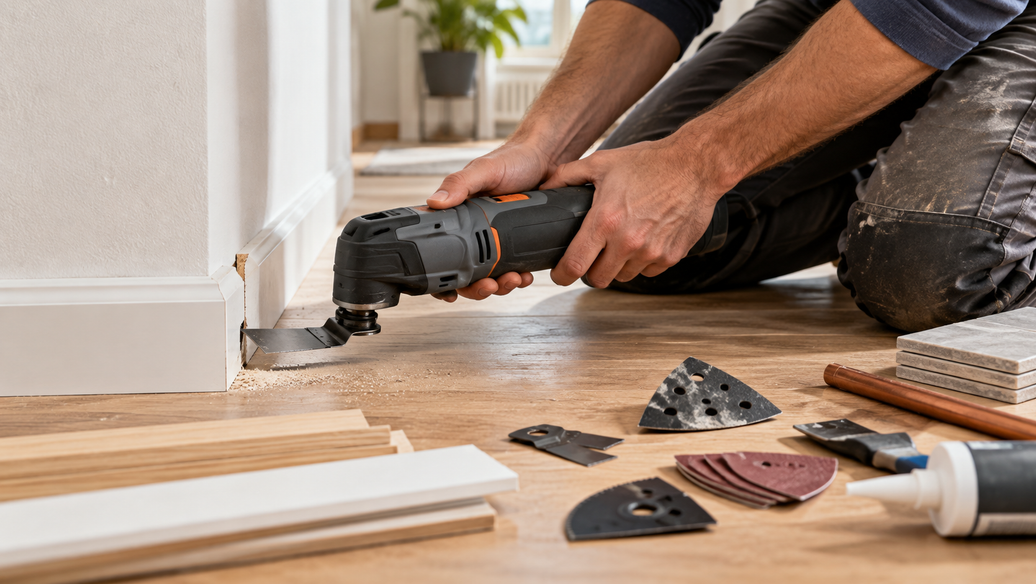
A multi-tool saw blade does not last indefinitely. How long you can use a saw blade depends on several factors, including the material, the quality of the blade, and how you use it. A dull or damaged blade not only makes working less pleasant, but can also cause you to work more slowly and less accurately.
But when is the time to actually replace your multi-tool saw blade? In this article, we explain what to look out for and how you can extend the life of your saw blades.
1. Sawing takes longer and longer
One of the clearest signs that a multi-tool saw blade is wearing out is that sawing noticeably slows down. Where you could previously cut through wood or plastic without difficulty, you suddenly have to apply much more pressure to achieve the same result.
This is usually a sign that the teeth of the saw blade are becoming dull. Applying more pressure often only helps temporarily and can also cause the blade and the multi-tool to become extra hot.
2. You have to apply more and more force
A sharp saw blade should do most of the work of cutting through the material. Of course, you need to guide the multi-tool, but you are not supposed to push it hard into the material.
Do you notice that you need more and more force? Then it is wise to check the saw blade. With a new, sharp saw blade, you will generally work faster and have more control over the machine.
3. The cut becomes less neat
A worn saw blade can cause a ragged or inaccurate cut. This is often particularly visible in wood. Instead of a clean cut, more splinters or burnt edges are created.
Does the final result need to look neat? Then it is wise to replace the saw blade in time and not wait until it is completely worn out.
4. The teeth are damaged or missing
Inspect the saw blade closely from time to time. Are several teeth damaged, bent, or completely broken off? Then the cutting performance will quickly deteriorate.
The teeth can become damaged, especially when you accidentally hit a nail or screw with a blade intended only for wood.
Therefore, when working with wood that may contain metal, it is best to use a suitable bi-metal saw blade.
5. The saw blade becomes noticeably hot
Sawing always generates some heat. However, if the saw blade becomes extremely hot within a short time, it may mean that the blade is dull or that you are applying too much pressure.
A dull saw blade causes more friction. This increases the temperature and can even cause the material to discolor or burn. In wood, for example, you will see dark or black edges around the cut.
6. The saw blade discolors
Blue, purple, or dark discoloration on a metal saw blade can indicate overheating. A single discoloration does not always mean that the saw blade is immediately unusable, but it can indicate that the material has become too hot.
If performance is clearly reduced afterwards, replacement is usually the best choice.
7. The multi-tool starts to vibrate more
Excess vibrations can have several causes. Therefore, first check whether the saw blade is properly attached. Is the blade correctly secured, yet the multi-tool still vibrates unusually during sawing? Then a damaged or unevenly worn saw blade may be the cause.
In that case, stop sawing and check the saw blade before continuing.
8. You get burn marks in the wood
Burn marks are a clear sign that too much heat is being generated during sawing. This can be caused by moving too slowly, applying too much pressure, or working with a dull saw blade.
If you have not changed your working method but burn marks suddenly appear? Then it is highly likely that the saw blade needs replacing.
How long does a multi-tool saw blade last?
There is no fixed number of minutes or meters after which a multi-tool saw blade must be replaced. The lifespan can vary greatly depending on the job.
For example, a blade used only for sawing soft wood may last much longer than the same type of blade that regularly encounters hardwood, nails, or other hard materials.
The quality of the saw blade also plays an important role. A good saw blade that is suitable for the right material will generally last longer and stay sharp for longer.
How to make your multi-tool saw blade last longer
By working in the right way, you can significantly extend the life of your saw blades.
- Always use a blade that is suitable for the material.
- Do not apply unnecessarily high pressure to the multi-tool.
- Let the saw blade do the work.
- Move the saw blade slightly back and forth during longer cuts.
- Avoid prolonged heat buildup.
- Use a bi-metal saw blade when you may encounter nails or screws.
- Regularly check whether the saw blade is still properly and securely attached.
Use the right blade for every job
A major cause of rapid wear is using the wrong saw blade. A standard wood blade, for example, is not intended for sawing through metal screws.
There is a suitable type of saw blade for every application:
- Wood blade: for wood, MDF, particleboard, and similar materials.
- Bi-metal blade: for wood with nails, screws, and thin metal.
- Carbide blade: for harder and more abrasive materials.
- Diamond blade: for joints and stone-like materials, among others.
When is replacement the best choice?
You do not need to wait until all the teeth on the saw blade have disappeared. As soon as you notice that sawing is clearly slower, you have to apply more force, or the quality of the cut deteriorates, it is often more efficient to install a new blade.
A sharp saw blade works faster, more accurately, and more pleasantly. Moreover, you avoid having to apply unnecessarily high pressure to your multi-tool.
Is your multi-tool saw blade due for replacement?
View MultiToolWorld's range of multi-tool saw blades and choose the right blade for wood, metal, plastic, joints, or other materials.